
Alberta OHS Code Part 41: The Complete Guide to Rope Access Regulations in Alberta
How APEX Rope Industries Navigates Canada’s Most Comprehensive Rope Access Standard — From Alberta to Every Province

An industrial rope access technician is suspended on a tall processing tower at an Alberta facility, overlooking an industrial plant with mountains in the distance.
Rope access work in Canada has grown exponentially over the past decade, with industrial rope access technicians now essential to maintaining and inspecting infrastructure that would otherwise require expensive scaffolding, cranes, or temporary structures. From the energy sector in Alberta to hydroelectric installations in British Columbia and telecommunications infrastructure spanning the country, rope access has become the standard for working at heights in challenging environments. Yet with this growth comes significant responsibility: improper rope access practices result in serious injuries and fatalities each year. This reality is why Alberta’s Occupational Health and Safety (OHS) Code Part 41 Work Requiring Rope Access represents one of the most rigorous and comprehensive rope access standards in North America. For companies like APEX Rope Industries, headquartered in Calgary, Alberta, understanding and exceeding Part 41 requirements is not merely a compliance obligation; it is a foundational commitment to worker safety and operational excellence. This guide walks through Part 41’s requirements, situates Alberta’s standard within the broader Canadian regulatory landscape, and demonstrates how APEX’s expertise ensures seamless compliance across provincial boundaries while maintaining the highest safety margins.
What Is Alberta OHS Code Part 41? Understanding Canada’s Most Rigorous Rope Access Regulation
Alberta OHS Code Part 41 governs all work requiring rope access, inspections, maintenance, and construction activities where workers are suspended or supported by rope systems. The regulation applies across all industries, including energy, utilities, construction, and more. It establishes mandatory requirements for equipment standards, system configurations, rescue procedures, and worker competency. Part 41 is distinctive in its prescriptive approach: rather than simply requiring “safe” rope access practices, it mandates specific technical standards that reflect best practices. The scope of Part 41 encompasses the entire rope access system, from the anchorage points to the personal protective equipment (PPE) worn by technicians, ensuring that no single point of failure compromises worker safety. A critical aspect of Part 41 is its emphasis on dual-rope systems, meaning that workers are always protected by at least two independent suspension ropes, each capable of supporting the worker’s full weight independently. This redundancy is fundamental to rope access safety and reflects decades of incident data showing that primary rope failures must never result in worker fatality. Additionally, Part 41 requires that equipment meet specific standards. Harnesses, carabiners, and other hardware must similarly meet recognized international certifications, and all equipment must be regularly inspected, documented, and retired according to manufacturer specifications.
Key Requirements Under Part 41: Breaking Down the Compliance Framework
Rope Standards and Equipment Certification
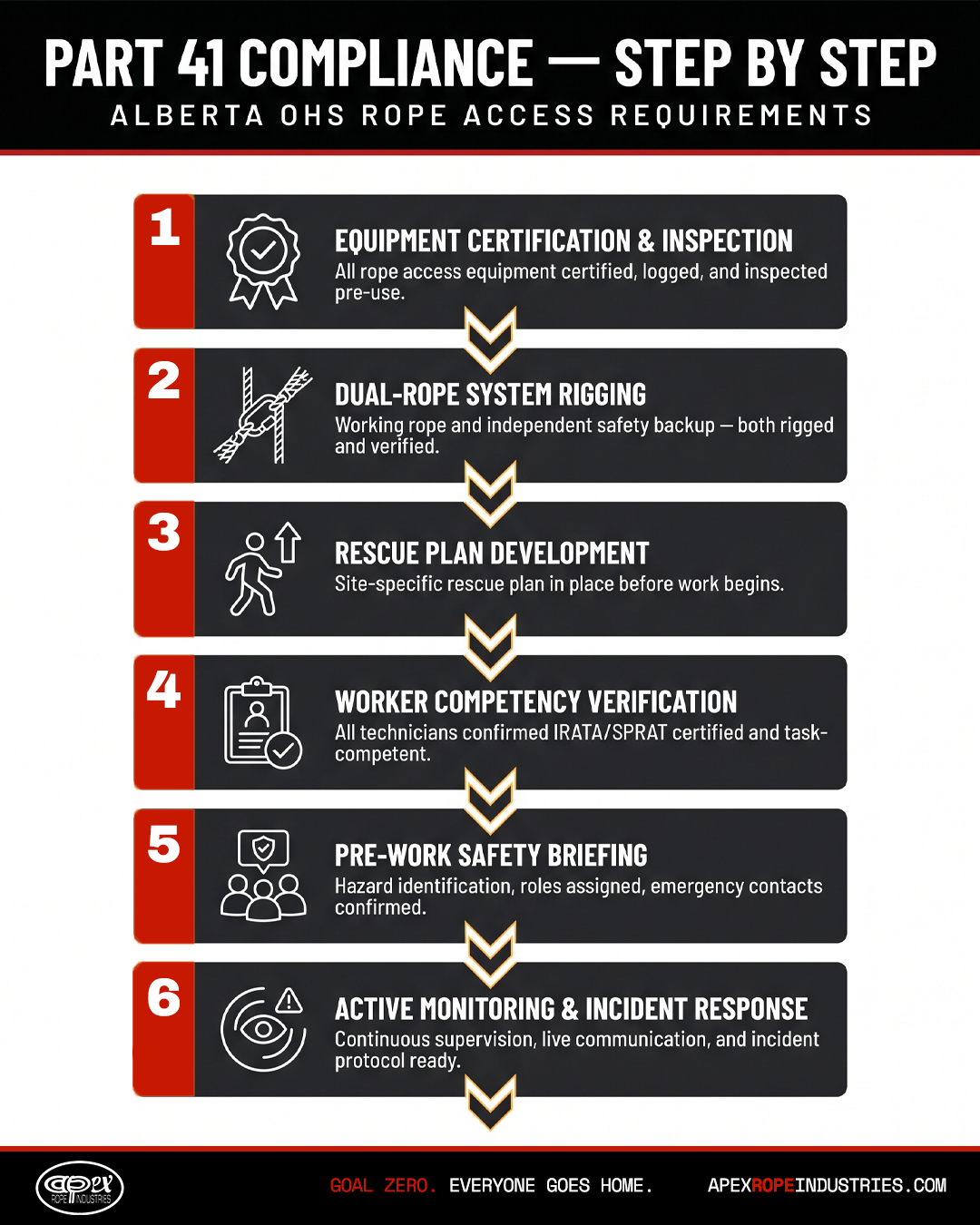
Part 41 specifies that all ropes must be certified under one of three international standards: CEN EN 1891, NFPA 2500, or UIAA 107. These standards define minimum breaking strength, elongation characteristics, and performance under impact loads. A dynamic rope certified to CEN EN 1891 Category A, for example, must withstand a minimum breaking strength of 22 kilonewtons and demonstrate consistent performance across a range of environmental conditions. Similarly, NFPA 2500 specifies rigorous testing for static ropes used in rescue operations, including requirements for low elongation and high abrasion resistance. APEX Rope Industries equipment inventory adheres to all three standards, enabling deployment across provincial jurisdictions and international projects. Beyond the primary suspension ropes, Part 41 requires that harnesses, carabiners, pulleys, and connectors meet applicable Canadian and international certification standards. APEX maintains detailed inventory records for all equipment, including purchase dates, inspection dates, and retirement schedules, ensuring that no degraded equipment enters service.
Dual-Rope Systems and Redundancy Requirements
One of Part 41’s most critical requirements is the mandatory use of dual independent rope systems. This means that each worker is suspended by two ropes, each anchored independently at a single anchor point or at separate anchor points. Each rope must have an independent attachment to the worker’s harness via separate carabiners. The rationale for this requirement stems from incident investigations showing that a single point of failure, whether rope breakage, anchor failure, or rigging error, becomes catastrophic without redundancy.
With dual-rope systems, the failure of one rope does not result in worker fatality; the second rope maintains suspension while the worker is recovered. Part 41 further specifies that one rope typically serves as the primary suspension rope while the second functions as a safety backup, though both must be actively managed during work. This distinction matters because it establishes clear roles: the primary rope carries the worker’s weight during normal operations, while the safety rope remains slack but immediately becomes load-bearing if the primary rope fails. APEX technicians are trained extensively in dual-rope rigging procedures and conduct pre-work inspections to verify that both ropes are properly anchored, correctly attached to the harness, and free from damage or contamination.
Rescue Planning and Emergency Procedures
Part 41 mandates that every rope access project must include a comprehensive rescue plan developed before work begins. The rescue plan must identify rescue personnel, recovery methods, equipment requirements, and communication protocols. It must address scenarios where a worker becomes incapacitated while suspended, detailing the specific procedures and equipment necessary to recover the worker safely and prevent secondary injuries. For projects in remote locations or extreme environments, the rescue plan may involve establishing secondary rescue teams, pre-positioning equipment, or coordinating with external emergency services. APEX maintains dedicated rescue kits at each project site and employs trained personnel.
Worker Competency and Training Requirements
Part 41 establishes that only workers who have completed recognized rope access training may perform rope access work. The regulation identifies IRATA (International Rope Access Trade Association) and similar organizations as valid certifying bodies. IRATA certification in Canada typically requires completion of a three-level training progression: Level 1 (basic rope access technician), Level 2 (intermediate), and Level 3 (advanced/supervisor). Each level requires documented classroom and field training, practical competency assessments, and recurring recertification every three years. APEX requires that all technicians maintain current IRATA certification, and supervisory personnel hold Level 3 credentials. Beyond initial certification, Part 41 obligates employers to provide ongoing training addressing site-specific hazards, new equipment, changes to procedures, and competency refreshment. This ongoing training requirement recognizes that knowledge degradation occurs over time and that industry practices evolve. APEX conducts competency assessments and provides ongoing training.
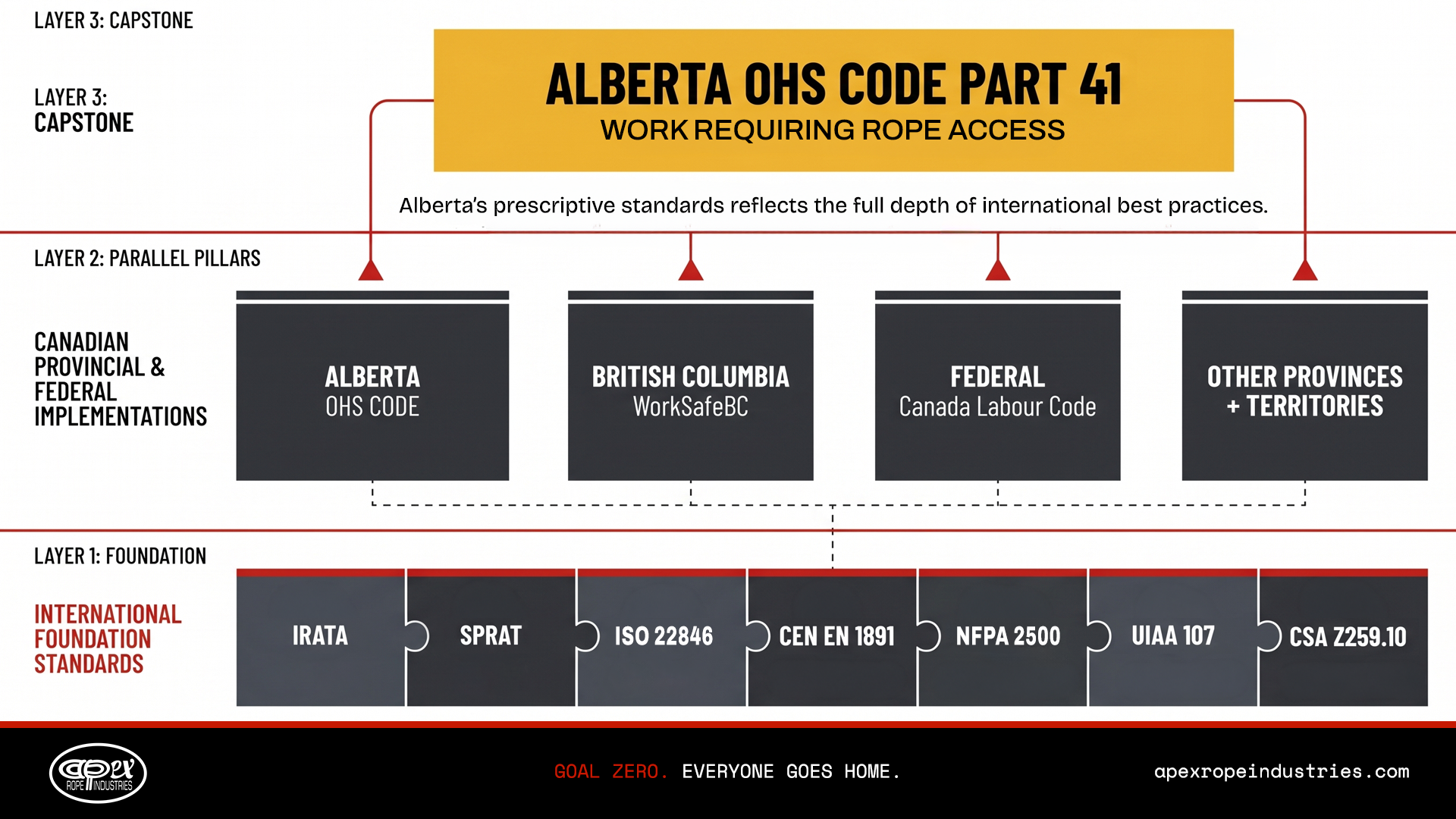
The international and Canadian regulatory framework underpinning Alberta OHS Code Part 41 — built on IRATA, SPRAT, ISO 22846, and CSA Z259.10 standards, implemented provincially through Alberta OHS, WorkSafeBC, and the Canada Labour Code.
How Part 41 Compares Across Canada: Understanding Provincial Variations and Harmonization
While Alberta OHS Code Part 41 is a comprehensive rope access regulation, the country’s federal system means that each province and territory has jurisdiction over occupational health and safety within its borders. This creates a complex regulatory landscape for organizations like APEX that operate nationally. However, significant harmonization has occurred in recent years, with most provinces adopting standards substantially similar to Alberta’s approach.
British Columbia’s WorkSafeBC Part 34 is perhaps the closest provincial equivalent to Alberta’s Part 41, with nearly identical technical requirements for rope standards, dual-rope systems, and rescue procedures. Organizations operating in both provinces can typically maintain a single set of standards and procedures, as the regulations are substantially harmonized. Quebec uniquely emphasizes French-language documentation and incorporates Commission de la santé et de la sécurité du travail (CSST) standards, but equipment requirements remain aligned with international norms. For APEX, this regulatory convergence enables the company to establish a single, comprehensive training and equipment program that exceeds all provincial requirements, ensuring that technicians and equipment are compliant when deployed to any Canadian jurisdiction.
International Benchmarks: IRATA, SPRAT, and ISO 22846: How Standards Connect
Alberta OHS Code Part 41, while provincial, draws heavily from international rope access standards and organizations. Understanding these international frameworks illuminates why Part 41’s requirements exist and how they position Canada at the forefront of occupational rope access safety. IRATA (International Rope Access Trade Association), founded in 1986, represents the industry’s primary international certifying body. IRATA standards have become the global benchmark for rope access competency, with Level 1, 2, and 3 certifications recognized across Europe, Australia, North America, and increasingly in Asia and the Middle East. IRATA’s curriculum emphasizes practical rope access techniques, rescue competency, and decision-making under stress, precisely the competencies that Canadian regulations require. SPRAT (Society of Professional Rope Access Technicians), primarily active in the United States, offers similar certifications with slightly different emphasis but equivalent technical rigour. Both IRATA and SPRAT certification programs require that trainees complete approximately 40 hours of classroom instruction, 40 hours of practical field training, and successfully pass written and practical examinations. Critically, both organizations require recertification every three years, preventing knowledge degradation and ensuring that certified technicians remain current with evolving practices. ISO 22846-1:2003, an international standard for rope access fundamental principles, further codifies the technical and procedural requirements that Alberta (and other Canadian provinces) have adopted. ISO 22846 specifies that rope access systems must meet certain characteristics regarding redundancy, load distribution, and emergency response. By anchoring Part 41 in IRATA, SPRAT, and ISO standards, Alberta ensures that its regulations reflect global consensus on rope access safety rather than regional idiosyncrasies, enabling companies like APEX to operate across borders with confidence that their training and equipment meet international norms.
APEX EXPERT INSIGHT — APEX operates across Alberta, British Columbia, and federal jurisdictions with a single unified training program that exceeds all provincial and territorial requirements. By anchoring operations in IRATA certification and maintaining equipment to the most stringent international standards, APEX eliminates compliance complexity for clients and ensures that every technician deployed to a project brings the same high level of competency and safety consciousness, regardless of jurisdiction. This philosophy has made APEX the preferred partner for national contractors managing multi-province rope access projects.
Why Compliance Matters: Real-World Implications and Enforcement Landscape
Compliance with Alberta OHS Code Part 41 is not merely a bureaucratic formality; it carries substantial legal, financial, and moral consequences. Non-compliance exposes employers to regulatory enforcement actions, financial penalties, criminal liability in cases of serious injury or fatality, and reputational damage that can undermine future business opportunities. Alberta’s Occupational Health and Safety branch and provincial Workplace Health and Safety inspectors conduct compliance audits for organizations engaged in rope access work, with particular scrutiny directed toward equipment certifications, training records, rescue planning documentation, and incident reports. An inspection might examine whether ropes have been certified to required standards, whether dual-rope systems are properly rigged and documented, whether rescue plans exist and are accessible to workers, and whether training records demonstrate that all technicians maintain current certifications. Non-compliance findings are categorized by severity: minor administrative deficiencies may result in a written directive to correct conditions within a specified timeline, while failure to maintain rescue capability or to use certified equipment may result in immediate stop-work orders and substantial fines. Beyond regulatory penalties, an organization involved in a serious injury or fatality incident receives intensive scrutiny, with investigations resulting in criminal charges against company officers and supervisors under Canada’s Occupational Health and Safety Act. These charges can result in imprisonment and permanent reputational damage. Conversely, organizations demonstrating excellent compliance records and proactive safety cultures, like APEX, build trust with clients, attract the highest-calibre workers, and secure contracts that non-compliant competitors cannot access.
Conclusion: Navigating Rope Access Compliance as Your Trusted Partner
Alberta OHS Code Part 41 represents a high standard for rope access safety, establishing prescriptive requirements for equipment, systems, training, and procedures that reflect international consensus on best practices. For organizations operating in Alberta, Part 41 compliance is non-negotiable; it protects workers, shields companies from regulatory and legal exposure, and enables access to high-value national contracts. Understanding Part 41’s requirements, from the international rope standards (CEN EN 1891, NFPA 2500,UIAA 107) to the mandatory dual-rope systems, rescue planning obligations, and competency standards, is essential for any company engaged in rope access work. The comparative regulatory landscape reveals that most Canadian provinces and territories have adopted standards substantially aligned with Alberta’s, creating harmonized requirements that organizations can navigate with a single, unified program. International benchmarks from IRATA, SPRAT, and ISO further validate that Alberta’s requirements position the province at the forefront of global rope access safety. APEX Rope Industries brings more than a decade of experience navigating this complex landscape.
Based in Calgary, Alberta, APEX has built a reputation as Canada’s most reliable partner for rope access consulting, training, and project execution. Our team of IRATA-certified technicians, comprehensive rescue capability, and unwavering commitment to safety have established us as the preferred partner for clients across the energy, utilities, construction, and telecommunications sectors. Whether you’re designing a rope access program, seeking training for your team, or looking to outsource rope access operations, APEX brings the expertise, certifications, and safety culture that Part 41 demands. Contact APEX Rope Industries today to discuss how we can support your rope access initiatives across Alberta and beyond.