
Fall Protection in Alberta and Across Canada: What the 2026 Standards Demand
APEX Rope Industries Breaks Down Alberta OHS Part 9, CSA Z259, and the Provincial Differences Every Safety Manager Must Know
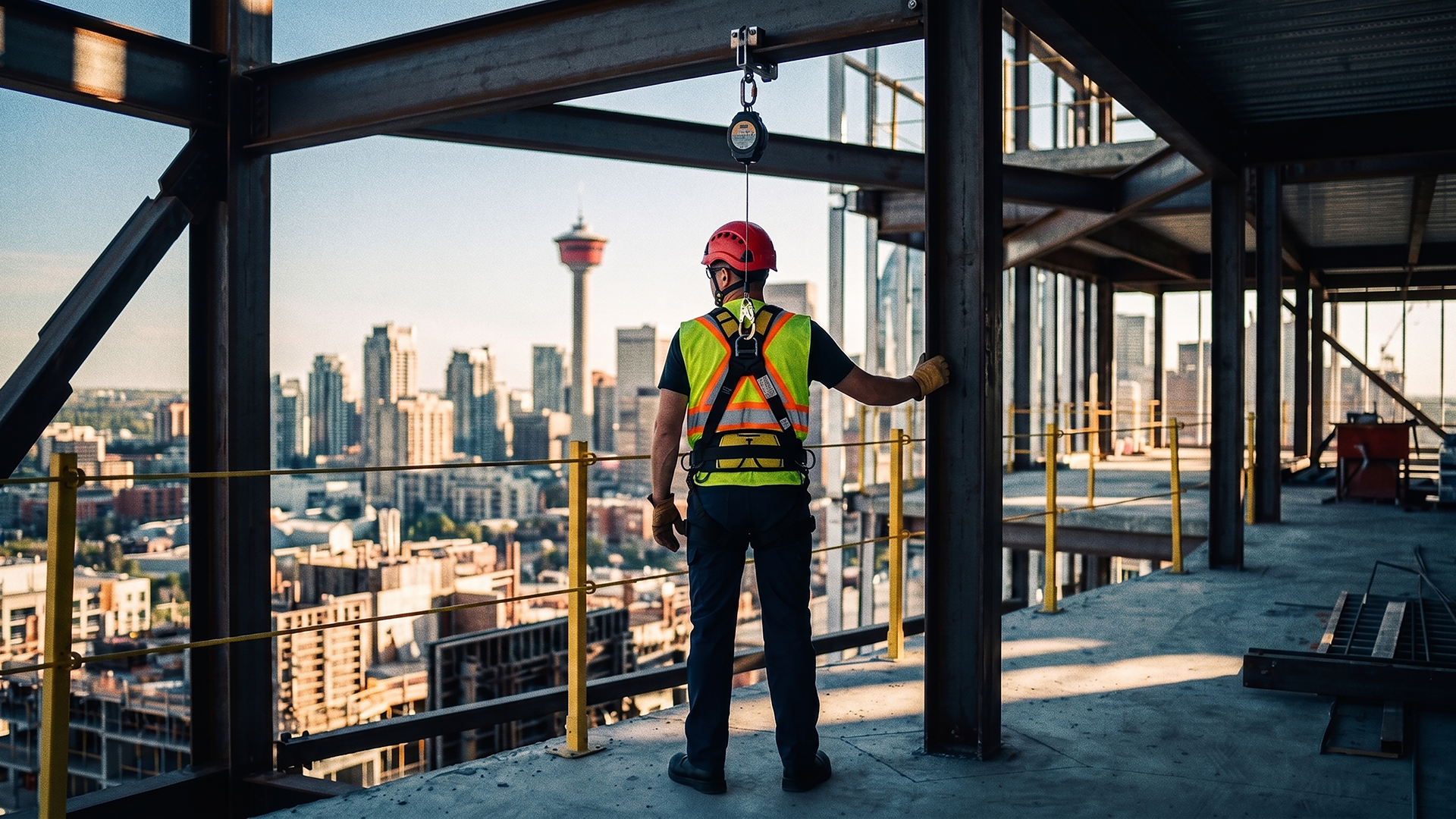
A rope access technician rigged in a full fall protection harness above the Calgary skyline — dual ropes and carabiners actively engaged.
Every year, falls remain one of the leading causes of workplace injuries and fatalities across Canada. In Alberta alone, Workers' Compensation Board (WCB) data consistently shows that falls account for a significant percentage of all workplace injuries—and notably, fall protection violations consistently rank as the top health and safety violation across the nation. When a worker falls from height, the consequences are devastating: severe injuries, lost productivity, investigations, fines, and, in the worst cases, loss of life. Yet fall protection remains one of the most misunderstood and inconsistently applied safety requirements in Canadian workplaces. APEX Rope Industries, headquartered in Calgary, Alberta, has spent two decades helping industrial clients across Canada navigate the complex, evolving landscape of fall protection standards. As regulations tighten and provincial codes diverge in 2026, understanding your jurisdiction's specific requirements is no longer optional—it's essential to protecting your workforce and your organization's liability. This comprehensive guide breaks down what the standards demand, highlights the critical differences between provinces, and provides actionable steps for building a fall protection program that keeps workers safe from coast to coast.
Alberta OHS Code Part 9: The Foundation of Fall Protection
Alberta's Occupational Health and Safety Code establishes Part 9: Fall Protection, which applies to all work at heights in the province. The Alberta OHS Code Part 9 framework is built around a hierarchy of controls that prioritizes elimination and engineering solutions before relying on personal protective equipment. Understanding this hierarchy is fundamental to developing a compliant fall protection plan in Alberta. The first line of defence is elimination: remove workers from heights entirely whenever possible. When that's not feasible, the code mandates engineered controls such as guardrail systems, which must meet specific construction standards (at least 1.0 to 1.2 metres high, with toe boards and mid-rails). Guardrails remain the most reliable and preferred method of fall protection when the work environment permits their installation. When guardrails are impractical, the next step in the hierarchy is travel restraint: a system that restricts a worker’s movement so they physically cannot reach an edge where a fall could occur. Because restraint prevents the fall from happening at all, it must be considered—and confirmed to be impracticable—before any fall arrest system is selected. Only once travel restraint has been ruled out does the hierarchy move to fall arrest, which is designed to stop a fall already in progress rather than prevent it. Horizontal lifelines belong to this fall arrest category: they provide an engineered anchor system for personal fall arrest, and they must be designed and installed by a qualified professional and be capable of withstanding the forces generated by a falling worker. At the bottom of the hierarchy sit the personal fall arrest systems themselves (harnesses, lanyards, and shock absorbers), which protect workers who cannot be kept away from heights. As the province's Part 9 guidance document explains, any fall protection plan must include hazard assessment, system selection based on the site's unique conditions, inspection protocols, rescue procedures, and documented worker training. This multi-layered approach ensures that no single failure—whether a damaged lanyard or a momentary lapse in judgment—results in a catastrophic fall.
CSA Z259 Series: Canada's National Fall Protection Standards
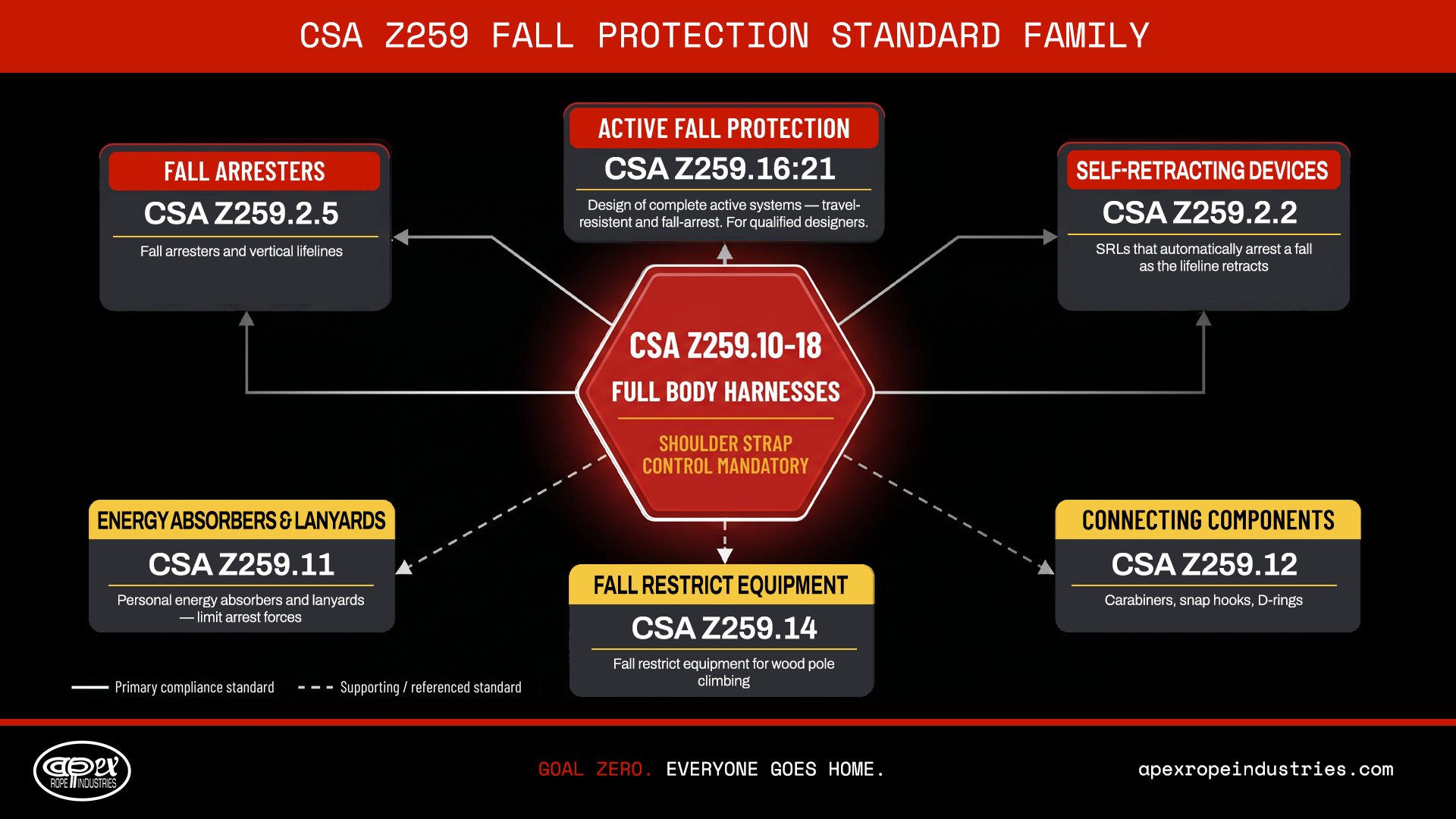
The CSA Z259 standard family maps every component of a compliant fall protection system — from full body harnesses to fall arresters, energy absorbers, and connecting hardware.
While provincial OHS codes establish the legal requirements, the Canadian Standards Association (CSA) develops the detailed technical standards that define how fall protection equipment must be manufactured, tested, and used. The CSA Z259 series is the nation's premier family of standards for fall protection, recognized and referenced by every province in Canada. CSA Z259.10-18 (Reaffirmed 2023) specifies requirements for full-body harnesses—the critical component that distributes fall forces across a worker's body. This standard mandates that harnesses include shoulder straps with control mechanisms to prevent the harness from riding up during a fall, significantly reducing the risk of internal injuries and suspension trauma. CSA Z259.2.5 covers fall arresters—the devices that stop a falling worker by either a mechanical or friction-based mechanism. These arresters must limit the force transmitted to the worker's body to no more than 6 kilonewtons (approximately 600 kg of force), ensuring that the deceleration does not itself cause injury. Under Alberta's updated standard, equipment may be rated to withstand up to 8 kilonewtons under specific conditions. CSA Z259.16-2021 specifies active fall protection systems, which are increasingly popular in industries like rope access and window cleaning because they allow continuous movement along a work surface while providing constant fall arrest capability. The 2018 revision to CSA Z259.10 introduced mandatory shoulder-strap control systems—a feature that marked a watershed moment in Fall Protection engineering. Before this standard revision, worker positioning during a fall was unpredictable and could result in suspension trauma, where the harness compresses critical blood vessels and causes unconsciousness or death even if the worker doesn't experience a hard impact. Shoulder strap control mechanisms now ensure that workers are maintained in an upright position, if worn properly, as prescribed by the manufacturer, significantly improving survival rates after a fall event. APEX Rope Industries emphasizes that understanding these CSA standards is critical: using non-certified equipment or misapplying standards-compliant equipment exposes workers and employers to both physical risk and regulatory liability.
Provincial Differences That Matter
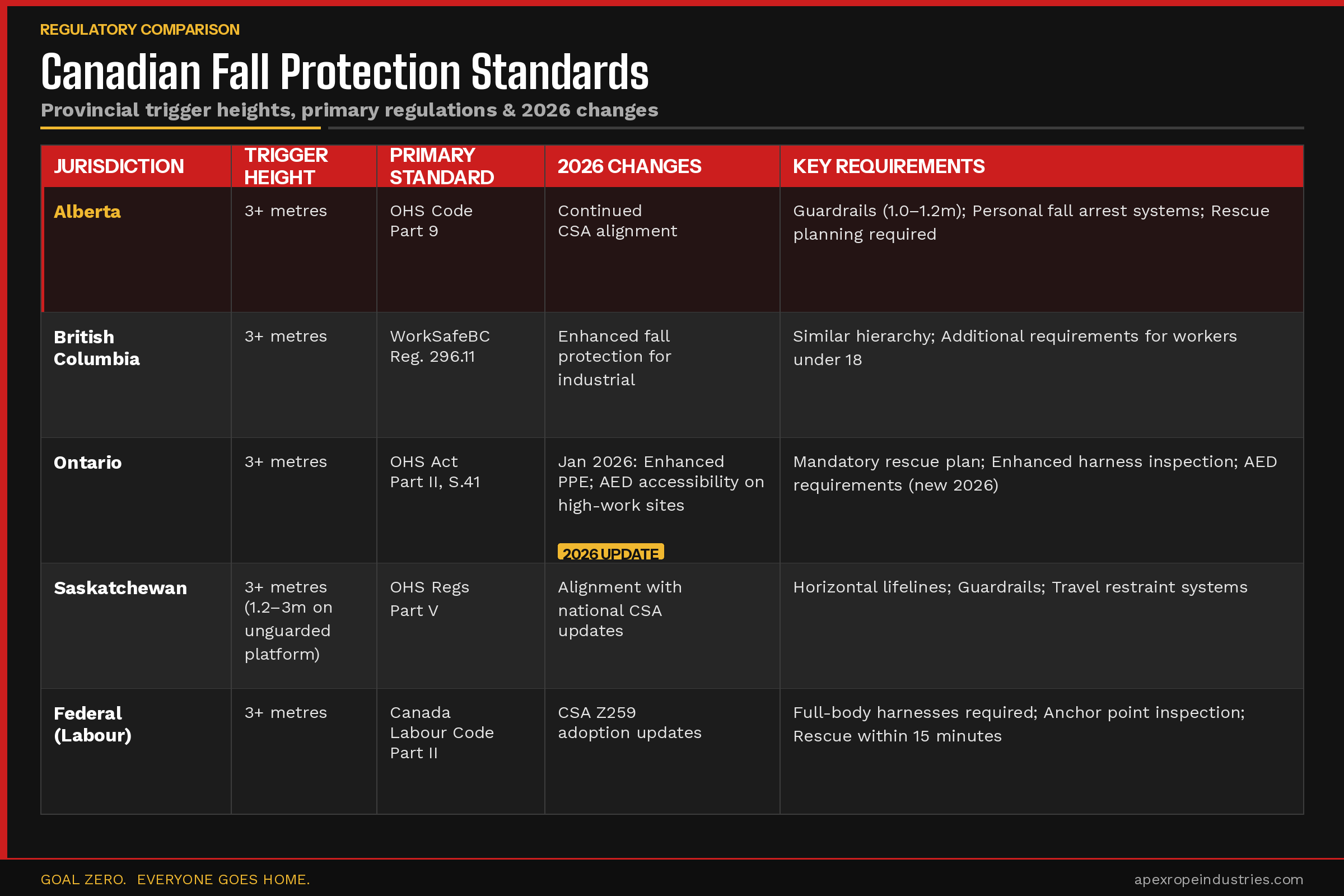
The comparison table above illustrates a critical reality: while all provinces reference CSA standards, the trigger heights and specific requirements vary significantly. In Alberta, fall protection is required at 3 metres (10 feet), or when an unusual risk of injury may exist—a provision that can apply even below that threshold depending on site conditions. British Columbia similarly requires fall protection at 3 metres for general work. Saskatchewan applies a 3-metre trigger as well, with an important additional provision: on working platforms not protected by a guardrail, fall protection is required between 1.2 metres and 3 metres. Federal jurisdiction and Ontario also align at 3 metres, with Ontario's standard further specifying that fall protection applies under 3 metres where the work surface below poses a risk. For organizations operating across provincial boundaries, these distinctions—particularly Saskatchewan's working platform threshold—demand careful attention to jurisdiction-specific protocols. Ontario's regulatory landscape shifted significantly in January 2026, when amendments to the OHS Act took effect. These changes include enhanced PPE requirements, mandatory automated external defibrillators (AEDs) on high-work sites, and stricter protocols for harness inspection and rescue planning. Workers in Ontario in 2026 will benefit from increased emergency response capabilities on job sites, but employers must budget for these new requirements and begin planning compliance now. British Columbia's WorkSafeBC division has been particularly rigorous in enforcement and has published detailed guidance documents that go beyond the minimum regulatory text. Federal jurisdiction—covering industries like interprovincial transportation, communications, and banking—applies a 3-metre standard but requires that rescue capability be available within 15 minutes, a requirement that forces organizations to invest in rescue teams or rapid-response contracts. The lesson for safety managers is straightforward: know your jurisdiction, document which standards apply to your operations, and maintain flexibility in your systems to accommodate the most stringent requirement if your work crosses provincial lines.
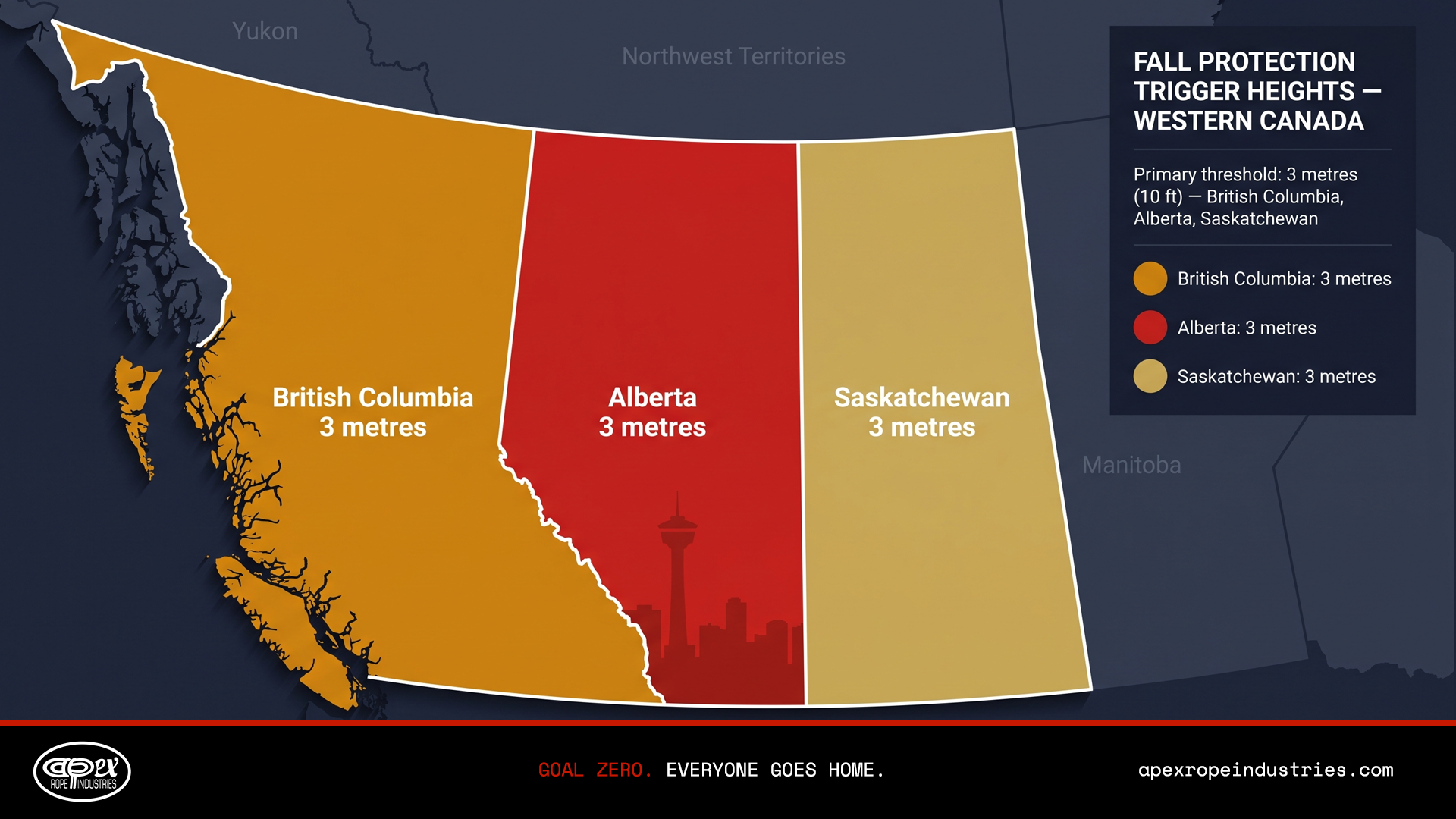
This infographic highlights provincial fall protection trigger heights in Western Canada, showing British Columbia, Alberta, and Saskatchewan all set at 3 metres.
Building an Effective Fall Protection Plan
A legally defensible fall protection plan is not a static document; it is a living system that responds to your workplace's unique hazards. The Alberta OHS Code Part 9 and corresponding CSA standards require that every employer with workers exposed to fall hazards conduct a thorough hazard assessment before work begins. This assessment must identify all locations where falls could occur, determine the height of potential falls, evaluate the surface on which a worker might land, and assess the structural integrity of any proposed anchor points. In Alberta, fall protection is required at 3 metres (10 feet), or under 3 metres where the work surface below poses a risk. On working platforms not protected by a guardrail, the requirement applies at 1.2 metres (4 feet) up to 3 metres (10 feet). A critical and often overlooked component of hazard assessment is the clearance requirement calculation. Before selecting and deploying a personal fall arrest system, safety planners must verify that sufficient clearance exists below the worker for the system to fully engage and arrest the fall during a dynamic event—accounting for free-fall distance, lanyard extension, deceleration distance, and the worker's height. This calculation is essential: a technically compliant system can still result in serious injury if inadequate clearance exists below the anchor point. For example, a roofing contractor working on a residential renovation must assess not only the roof height but also the condition of the roof surface (which affects slip potential), the presence of skylights or other openings (which increase the consequence of a fall), and the adequacy of existing structures to serve as anchor points. Once hazards are identified, the next step is system selection. This is where the hierarchy of controls becomes practical: Can guardrails be installed? If not, can a travel restraint system keep workers back from the edge entirely? Only where restraint is not practicable does the question become one of fall arrest: do site conditions permit a horizontal lifeline, or must workers rely on a personal fall arrest system? The choice depends on the specific work, the duration of exposure, and the site conditions. A fall protection system that is perfect for one job may be entirely inappropriate for another. After system selection comes fall protection equipment inspection and maintenance. All components—harnesses, lanyards, connectors, anchor systems, and associated hardware—must be inspected before each use by the worker and comprehensively inspected by a qualified person at least annually. A harness that has arrested a fall must be removed from service and either destroyed or sent to the manufacturer for inspection, depending on local requirements and the severity of the impact. Many organizations underestimate the administrative burden of fall protection equipment management: tracking inspection records, rotating equipment appropriately, and training workers to conduct thorough daily pre-use inspections of all gear. Rescue planning is perhaps the most overlooked component of fall protection compliance. If a worker falls and becomes suspended in a harness, they must be rescued and brought to a safe location within a specific timeframe—typically 15 minutes—to avoid suspension trauma. This means that every work site with potential fall hazards must have a documented rescue plan, with trained personnel and appropriate equipment available. Some organizations contract with rope rescue teams; others train internal personnel. The critical point is that rescue capability must exist before work begins, not discovered as a gap after an incident occurs. Finally, worker training is non-negotiable. Workers must understand the hazards they face, the fall protection system being used, the correct way to don and inspect their equipment, how to identify damaged gear, emergency procedures, and the consequences of non-compliance. Initial training should be documented, and refresher training should occur at least annually or whenever procedures change.
The 2026 Landscape: What's Changing
As we progress through 2026, the fall protection landscape is evolving at an accelerating pace. Ontario's OHS Act amendments represent the most significant regulatory shift, but this change reflects a broader North American trend toward more rigorous fall protection requirements. The addition of AED requirements on high-work sites in Ontario is not merely bureaucratic; it reflects evidence-based medicine demonstrating that sudden cardiac events can be triggered by trauma, and that immediate defibrillation significantly improves survival rates. Employers operating in Ontario will need to ensure that AEDs are available on all sites where workers are at height, that all personnel on site receive training in AED use, and that maintenance contracts ensure devices are in working order. Beyond Ontario, the CSA continues to update the Z259 series based on incident data and emerging technologies. Fall arresters are becoming more sophisticated, with some newer models incorporating self-rescue capabilities that allow suspended workers to lower themselves to safety without awaiting rescue—a critical feature for remote work sites where rescue response times may exceed 15 minutes. Horizontal lifeline systems are being engineered with more flexibility and durability, reducing the cost and installation time compared to systems deployed just five years ago. The Canadian Centre for Occupational Health and Safety (CCOHS) has indicated that guidance documents on fall protection will be updated in 2026 to reflect these changes and provide clearer direction on innovative technologies that meet or exceed traditional requirements. For organizations planning capital investments in fall protection infrastructure—whether installing permanent anchor points, purchasing harnesses and lanyards, or contracting rescue services—the 2026 landscape offers both challenges and opportunities. The challenge is the need for continued training and system updates. The opportunity is access to superior technology and clearer guidance from regulatory bodies. Organizations that begin their 2026 compliance planning now, while budgets are being set and procurement decisions are being made, will find themselves well-positioned to adopt best practices rather than scrambling to meet deadlines.
A Call-to-Action
Fall protection is fundamentally about respect—respect for the physical integrity of the workers in your organization and respect for the regulations that exist to protect them. APEX Rope Industries' two decades of experience across Canada have taught us that every serious fall injury is preventable. The standards exist, the equipment works, and the knowledge is available. What often stands between a safe workplace and a tragedy is the decision to prioritize compliance and invest in systems that exceed minimum requirements. If your organization operates in Alberta, you must align with Alberta OHS Code Part 9. If you operate across provinces, you must meet the most stringent requirement that applies to any of your work sites. In 2026, you must be aware of Ontario's OHS Act changes and ensure that your protocols accommodate them. You must select fall protection systems based on rigorous hazard assessment, not convenience. You must inspect equipment regularly, maintain meticulous records, and train workers comprehensively. You must ensure that rescue capability is in place before work begins. APEX Rope Industries is ready to help. We provide comprehensive fall protection audits, rope access training certified to IRATA International standards, rescue team training, equipment procurement and maintenance, and consulting services to ensure that your organization meets or exceeds all applicable standards. Contact our Calgary headquarters to schedule a consultation, and let's ensure that every worker in your organization gets home safely every day. Because in fall protection, there is no acceptable margin for error—there is only excellence.
APEX EXPERT INSIGHT — APEX operates across Alberta, British Columbia, and federal jurisdictions with a single unified training program that exceeds all provincial and territorial requirements. By anchoring operations in IRATA certification and maintaining equipment to the most stringent international standards, APEX eliminates compliance complexity for clients and ensures that every technician deployed to a project brings the same high level of competency and safety consciousness, regardless of jurisdiction. This philosophy has made APEX the preferred partner for national contractors managing multi-province rope access projects.