
Five Grain Elevators, Three Provinces: Reinstalling Explosion Relief Panels With Minimal Downtime
A multi-site rope access case study from the Canadian prairies, and why more grain handlers are leaving the crane in the yard.
Introduction: The Panel You Hope Never Has to Do Its Job
Every grain elevator carries a quiet piece of insurance bolted to its walls. Explosion relief panels sit there for years doing nothing at all, and that is exactly the point. They exist for the worst day a grain facility can have.
So when explosion relief panels at five grain elevators across Alberta, Saskatchewan and Manitoba were dislodged during operations, the fix couldn't wait. A panel that isn't properly secured isn't just a maintenance item. It's a safety system that can't be trusted to perform the way it was engineered to.
The catch was the same one every elevator operator knows. The panels were up high on the structure, the facilities were running, and the usual answers meant a crane and a man-basket or a scaffold build, plus a shutdown to make room for either one.
The client called APEX Rope Industries. Our certified rope access technicians reinstalled the panels at all five sites, replacing fasteners and torquing to manufacturer specification, with minimal downtime. Five sites delivered. Zero dropped objects. Production was down only briefly.
Here's how that happened, and why grain elevator maintenance is one of the clearest cases for rope access we know of.
At a Glance
Scope: Reinstallation of dislodged explosion relief panels, including fastener replacement torqued to manufacturer specification
Locations: Five grain elevators across Alberta, Saskatchewan and Manitoba
Access method: Certified industrial rope access. No crane, no man-basket, no scaffolding
Results: Zero dropped objects, minimal downtime, all five sites returned to spec
Credentials: IRATA-certified. APEX trains to IRATA and NFPA standards. APEX is ISNetworld, Avetta, and COR-certified through the ACSA.
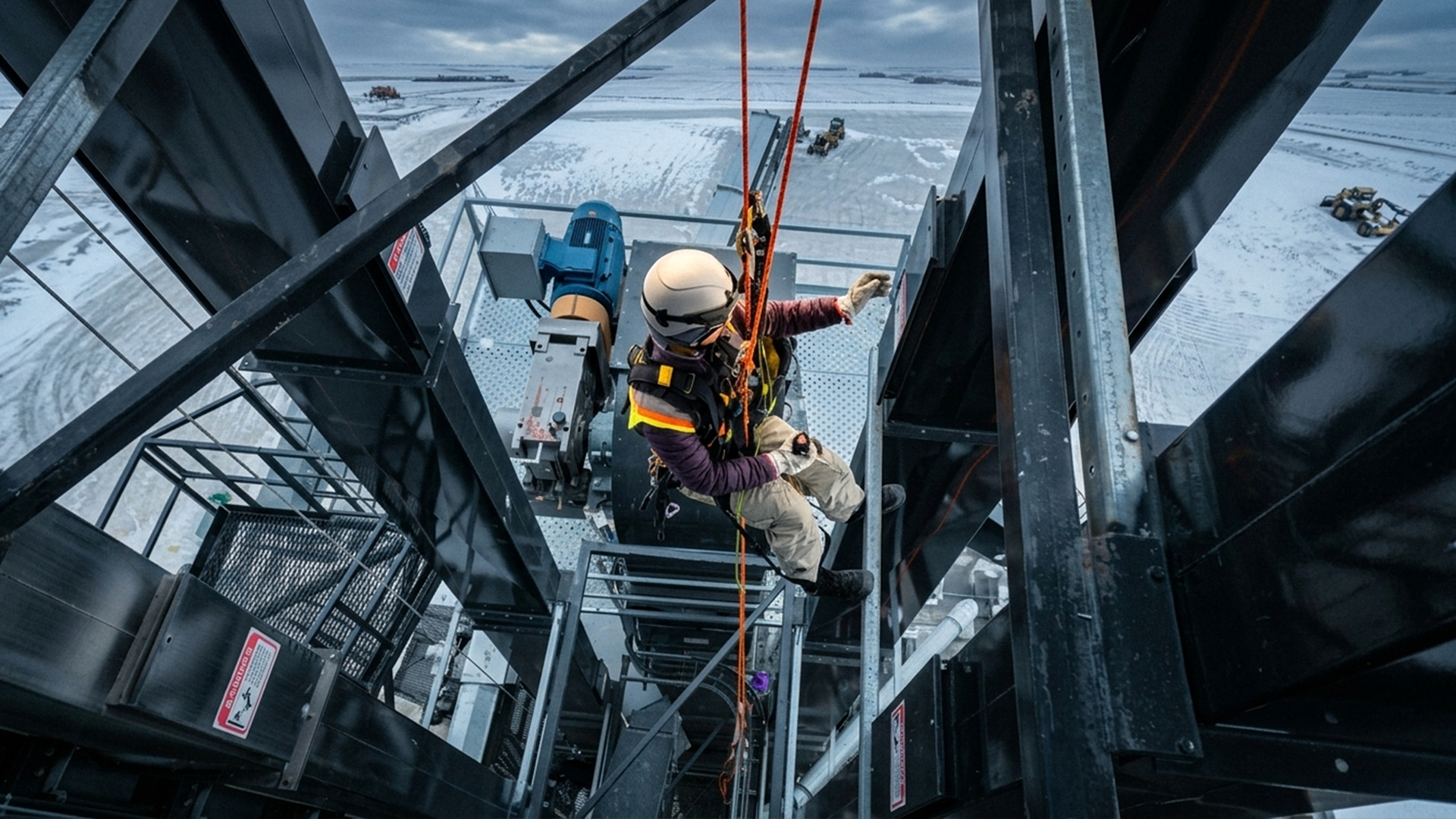
Winter on the prairies: an APEX technician works on two ropes inside a grain elevator headframe, high above the yard.
What Is an Explosion Relief Panel?
An explosion relief panel, also called an explosion vent or deflagration vent, is an engineered panel designed to release at a set pressure. If combustible grain dust ignites inside an enclosure, the panel opens and directs the pressure and flame out of the structure, limiting damage to the building and reducing risk to the people around it. Deflagration venting is covered by NFPA 68, and dust explosion prevention in agricultural facilities by NFPA 61.
Grain dust is combustible, which is why these panels appear throughout elevator head houses, legs, bins and galleries. It's also why a dislodged panel is taken seriously. A vent is only as reliable as its installation. The wrong fasteners, missing fasteners or incorrect torque can change how a panel behaves, and that is not something an operator wants to discover on the one day it matters.
That's the part of this job that doesn't show up in a photo. The work wasn't just about getting panels back on the wall. It was about putting them back exactly the way the manufacturer designed them to be held.
The Challenge: Five Sites, Three Provinces, Minimal Downtime
Any one of these panels would have been a routine task on the ground. The problem was everything around them.
The work was at height. Panels were on elevated exterior surfaces of the elevators, well out of reach of ladders or fixed platforms.
Downtime had to be minimal. Grain elevators run on tight windows, and every idle hour means lost throughput. Production paused only while crews worked on the panels, and the stoppage stayed short.
It was five sites, not one. The scope was spread across three provinces, so whatever access method was chosen had to be repeated, mobilized and demobilized five times.
It was winter on the prairies. Cold, wind and short daylight add friction to every access method, and to every heavy piece of equipment that has to be trucked in.
Multiply the cost and disruption of conventional access by five, and the maintenance plan starts to look like a capital project.
Why a Crane or Scaffold Was the Wrong Tool
When a panel comes loose at height, the conventional playbook offers two paths. Both work. Both are expensive in ways that compound across a multi-site program.
Crane and man-basket. A crane needs to be booked, mobilized, set up on stable ground and staffed with an operator and rigger. Elevator sites are crowded with rail spurs, truck lanes, conveyors and bins, so finding a safe setup position can mean closing the same traffic the facility depends on. In cold and wind, lift windows narrow further.
Scaffolding. A scaffold tall enough to reach elevated panels means engineering, materials, a build crew, inspection and then a teardown. That's days of labour to support work that takes hours, and the structure occupies ground the facility needs.
The shutdown cost. Both options frequently require operations around the work area to pause. For a grain elevator, that's the most expensive line item of all, and it doesn't appear on the contractor's invoice.
Rope access takes a third path. Instead of bringing a structure to the wall, technicians use the elevator's own structure, rigging to suitable anchors and working directly at each panel.
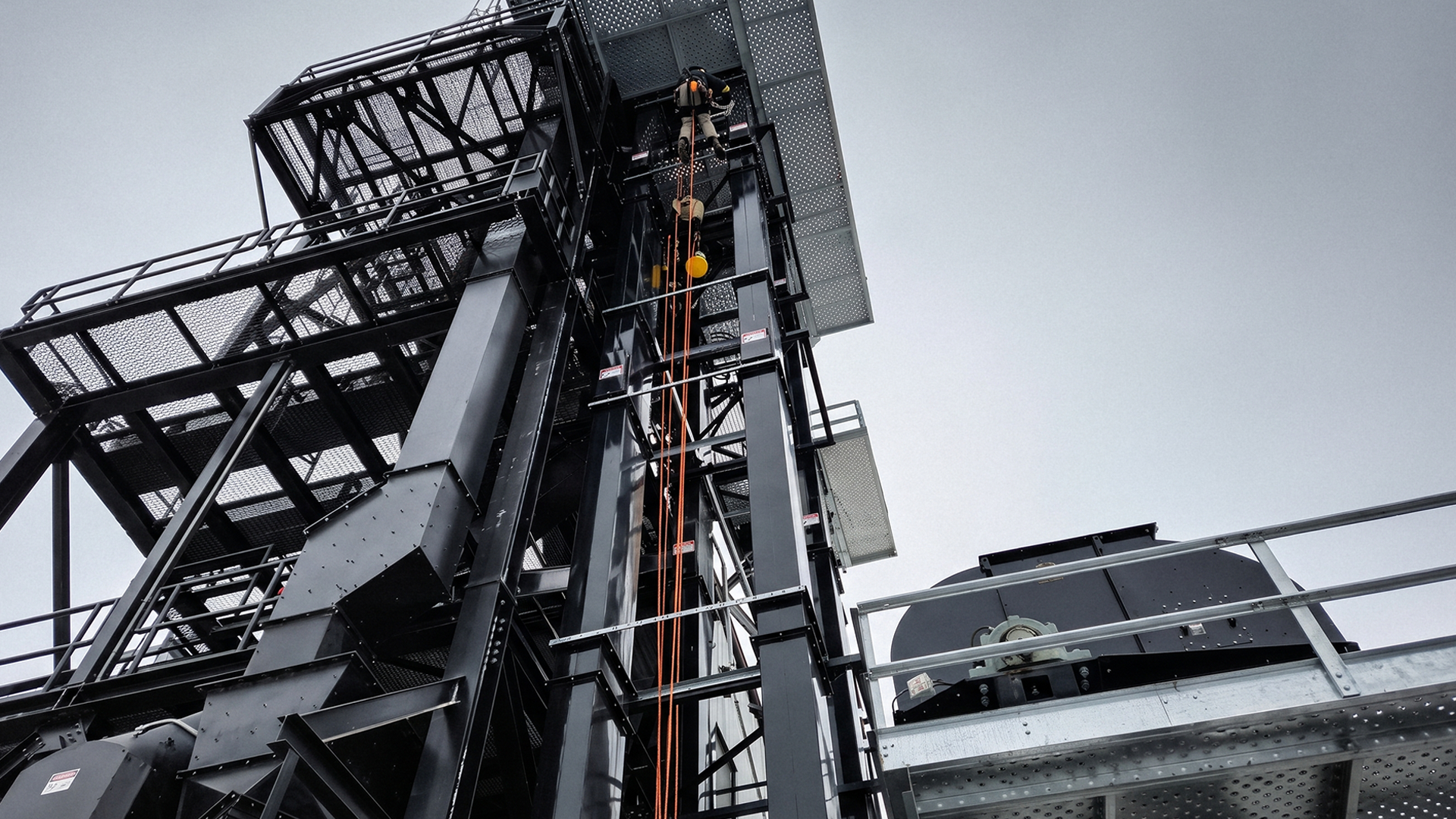
Instead of bringing a crane or scaffold to the structure, APEX rigs to the elevator’s own steel and works straight down from above.
The Solution: How APEX Reinstalled the Panels
The method was the same at every site, and that consistency is a big part of why the program worked.
Plan the access. Each site was assessed for anchor locations, rope paths and work zones before anyone went over the edge, with a rescue plan in place for every work position.
Rig a two-rope system. Every technician, in a full body harness, worked on two independent ropes, a working line and a safety line, each capable of holding their full weight on its own.
Replace the fasteners. Rather than reusing what was there, fasteners were replaced so every panel went back on with sound hardware.
Torque to manufacturer spec. Each panel was secured to the manufacturer's specified torque, so the vent performs the way it was engineered to.
Control the zone below. Production was locked out for safety while the work took place. Preventing anything from falling was treated as part of the job, not an afterthought.
Demobilize and repeat. Rope access gear travels in a truck, not a convoy. The team packed out clean and moved to the next site.
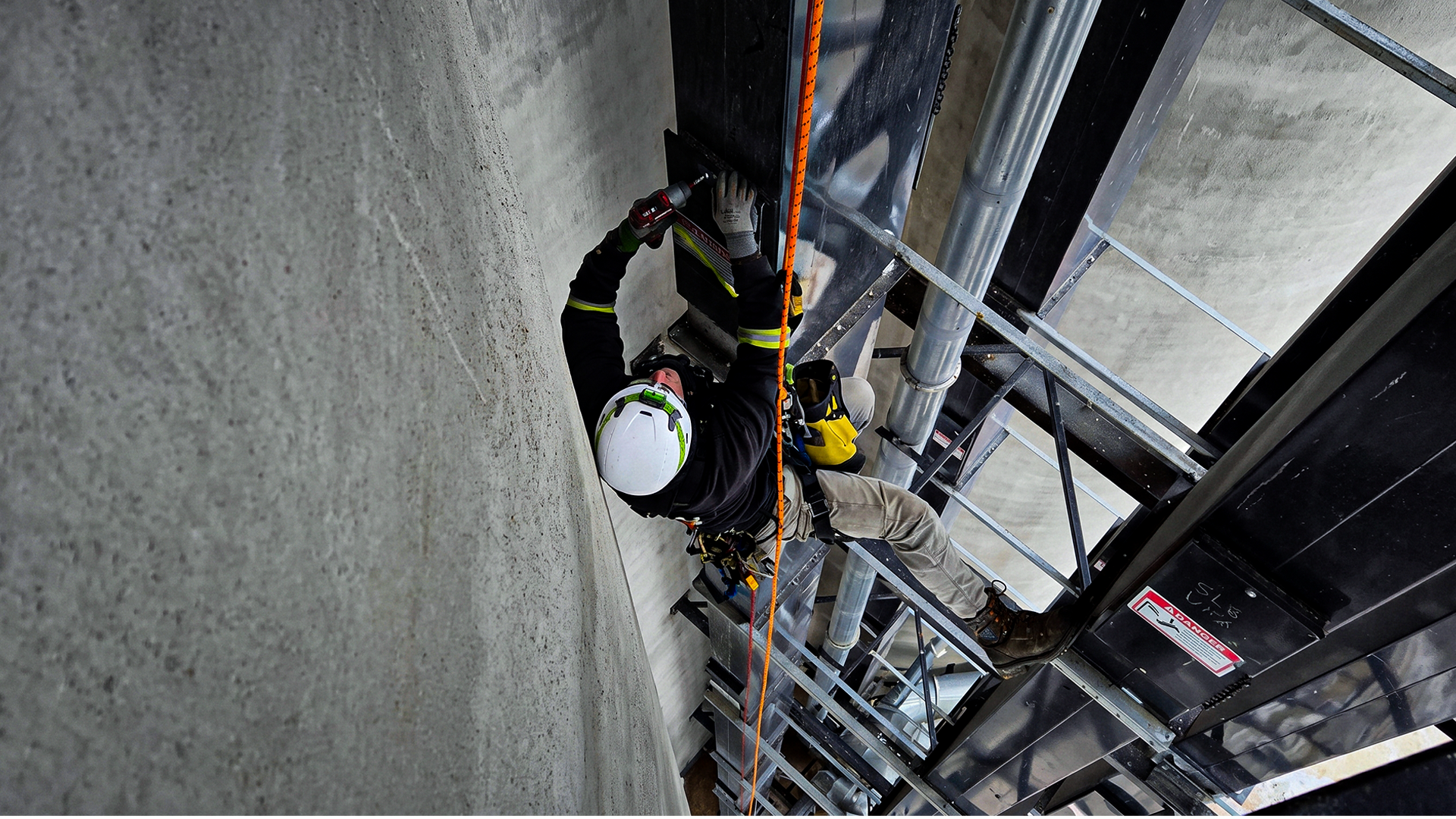
Working off rope, an APEX technician drives a replacement fastener on an explosion relief panel, secured to manufacturer torque specification.
How You Get to Zero Dropped Objects
Zero dropped objects across five active sites is the number in this case study that deserves the most attention. On a working elevator, the area beneath the technician is not empty. There are people, trucks and equipment moving through it all day.
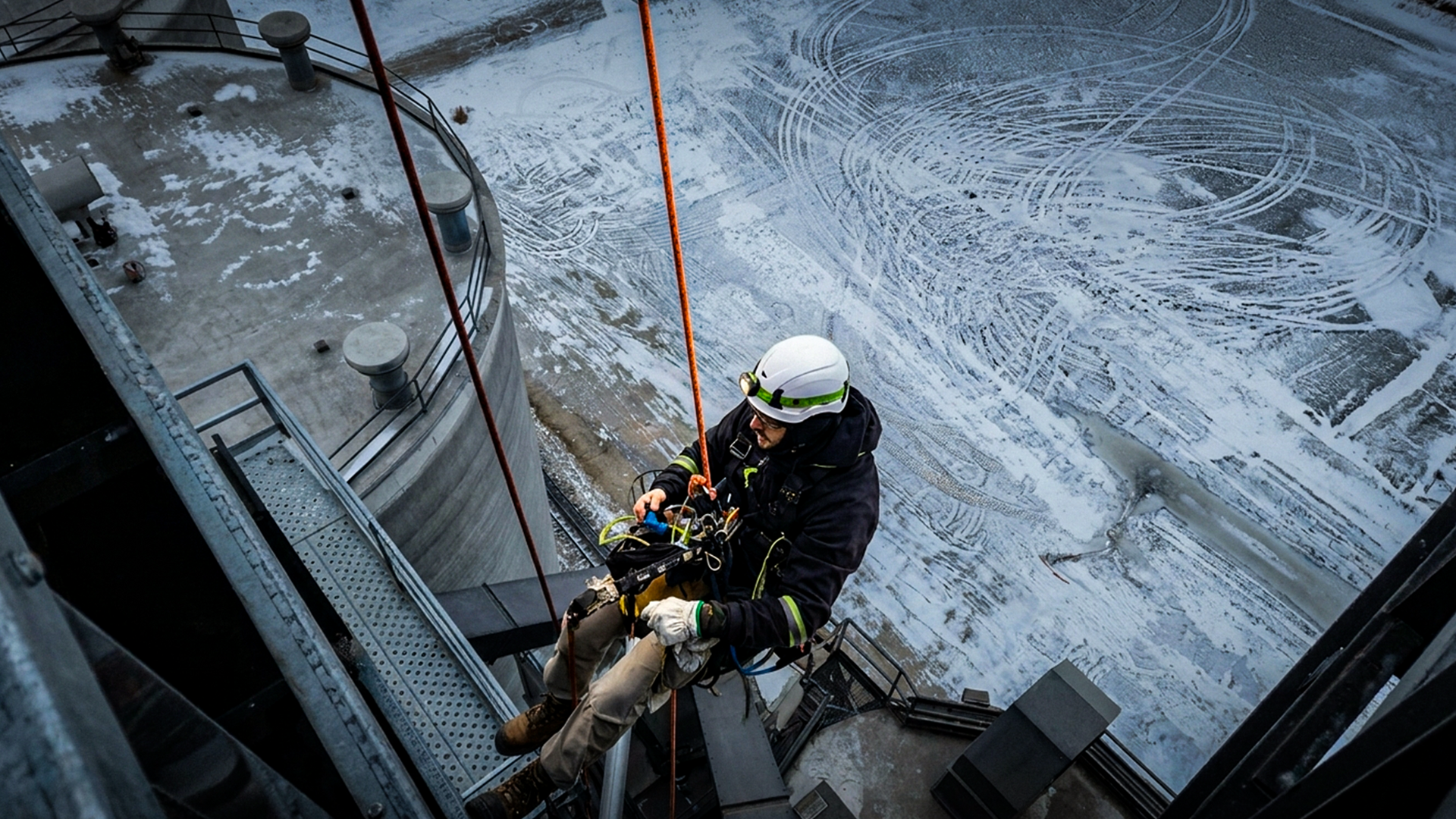
Looking down from the work position, the yard below is why every tool is tethered and the zone beneath is controlled.
Getting to zero isn't luck. In rope access, dropped-object prevention is a discipline built into the work itself:
Tethered tools. Drills, sockets and hand tools are attached to the technician or to the system, so a slip means a dangling tool, not a falling one.
Controlled hardware. Fasteners and small parts are carried in closed bags and pouches rather than pockets or open trays.
Exclusion zones. Work areas below are established and managed with the facility.
Deliberate movement. Technicians position before they work, not while they work, which keeps both hands and every tool under control.
That's the difference between a contractor who says safety matters and one who can put a zero on the board five times in a row.
The Results: Five Sites Back to Spec
Five grain elevators returned to spec across Alberta, Saskatchewan and Manitoba.
Zero dropped objects, with full site safety compliance at every location.
Minimal production interruption. Production paused only while the work was carried out, then resumed.
No crane mobilization, no scaffolding rental and no extended shutdowns at any of the five sites.
One happy client, with a multi-site maintenance scope closed out cleanly.
For a grain handler, the value lands twice. The explosion protection system was restored to its original design, and the facility gave up only a small amount of production time to get it done.
Why Rope Access Scales for Multi-Site Grain Operations
Rope access isn't a workaround. For the right scope, it's the most efficient and accountable method available, and that advantage grows with every site you add.
A crane or scaffold has a fixed cost to bring in and take down every time. Rope access doesn't carry that overhead. A certified team mobilizes with its equipment, works to the same method at each facility and moves on. Across five sites, that difference compounds into days saved and a maintenance budget that goes to maintenance rather than access.
It also means one standard of work across every location. The same certifications, the same two-rope discipline and the same documentation apply in Alberta, Saskatchewan and Manitoba alike. For operators managing a network of elevators, that consistency is worth as much as the speed.
Explosion panel reinstallation is one scope among many. Rope access fits well for elevator and terminal work such as structural inspection of bins and head houses, cladding and panel repair, sealing and fastener replacement, and coating and corrosion work on exterior surfaces. For a look at rope access on another working agricultural site, see our case study on emergency chute repair at an agricultural facility.
APEX Expert Insight
When a facility manager hears "rope access," they sometimes picture a shortcut. It's the opposite. Every technician on this program was on two independent ropes, working to a rescue plan, with every tool tethered and every panel torqued to the manufacturer's spec. The reason rope access is faster isn't that it cuts corners. It's that it removes the cranes, the scaffold and the extended shutdown, and leaves only the work. Across five elevators, that meant our client got their explosion protection back to spec with only a short pause in production.
Frequently Asked Questions
Can explosion relief panels be repaired without a long shutdown of a grain elevator?
Yes. With rope access, technicians work directly at the panel, so there is no need to build access around it. Lockout/tagout is in place while the work is done, and the work zone below is controlled to meet the facility's own safety requirements. Production is down only for a short time, and operations resume once the work is complete. On this program, each of the five elevators was down for only a small amount of time.
Is rope access safer than using a crane and man-basket?
Both can be performed safely. Rope access is built on a two-rope system, where each rope can hold the worker independently, backed by a rescue plan for every work position. It also removes the ground-level hazards that come with setting up heavy lifting equipment on a busy site.
What certifications should a rope access contractor have for grain elevator work?
Look for technicians certified through IRATA or SPRAT, work performed under provincial occupational health and safety regulations such as the Alberta OHS Code Part 41 rope access regulations, and contractor prequalification through platforms such as ISNetworld, Avetta or the Alberta Construction Safety Association.
APEX is an active IRATA-certified member. We train to IRATA and NFPA standards. APEX is ISNetworld, Avetta, and COR-certified through the ACSA.
Does APEX work outside Alberta?
Yes. This program covered grain elevators in Alberta, Saskatchewan and Manitoba, delivered with the same crew standards and method at every site.
Conclusion: Protection Back in Place, Minimal Downtime
Explosion relief panels are easy to forget until one comes loose. Then they become urgent, high up and in the way of a facility that can't afford long downtime.
Across five grain elevators and three provinces, APEX put those panels back the way they were designed to be held, with new fasteners torqued to spec, without a crane, without a scaffold and without a single dropped object. Each elevator was back in operation after only a short pause.
That's what certified rope access looks like on the prairies. Based in Calgary and working across Western Canada, APEX Rope Industries brings IRATA and NFPA certified technicians to the maintenance scopes conventional access makes slow and expensive.
Managing a grain terminal, processing facility or industrial structure with elevated maintenance on the list? Contact APEX Rope Industries to find out whether rope access fits your operation. GOAL ZERO. EVERYONE GOES HOME.