
When Every Hour Costs Money: How Rope Access Stopped a Grain Facility’s Product Loss in a Single Day
An emergency chute repair, a 48-hour mobilization, and zero dollars spent on scaffolding. A case study in why agricultural facilities are rethinking how they work at height.
Introduction: The Leak That Couldn’t Wait
Here’s a problem most people never think about until it’s theirs: product loss at height.
A material chute on an agricultural storage structure had developed leaks. Not in one spot, but at multiple points across the run. Every hour it stayed broken, product spilled and money drained. This wasn’t a repair that could wait for next quarter. The client needed it handled right away.
And that’s where the real problem started. The chute wasn’t at ground level. It was 80 feet in the air spanning between two storage bins, in the kind of spot that traditional access methods treat as a multi-day project. Scaffolding. Aerial lifts. Setup crews. Rental invoices. Days of lead time the facility simply didn’t have while the product kept hitting the ground.
The facility needed someone who could get up there fast, fix everything in one shot, and leave without turning the site into a construction zone. They are called APEX Rope Industries. Forty-eight hours later, a rope access team paired with the correct trade certification was on ropes. One working day after that, the leaks were gone.
This is the story of how that happened, and why more agricultural operations across Alberta, Saskatchewan and Manitoba are learning that the fastest way up isn’t the biggest machine on the lot. It’s two ropes and a technician who knows how to use them.
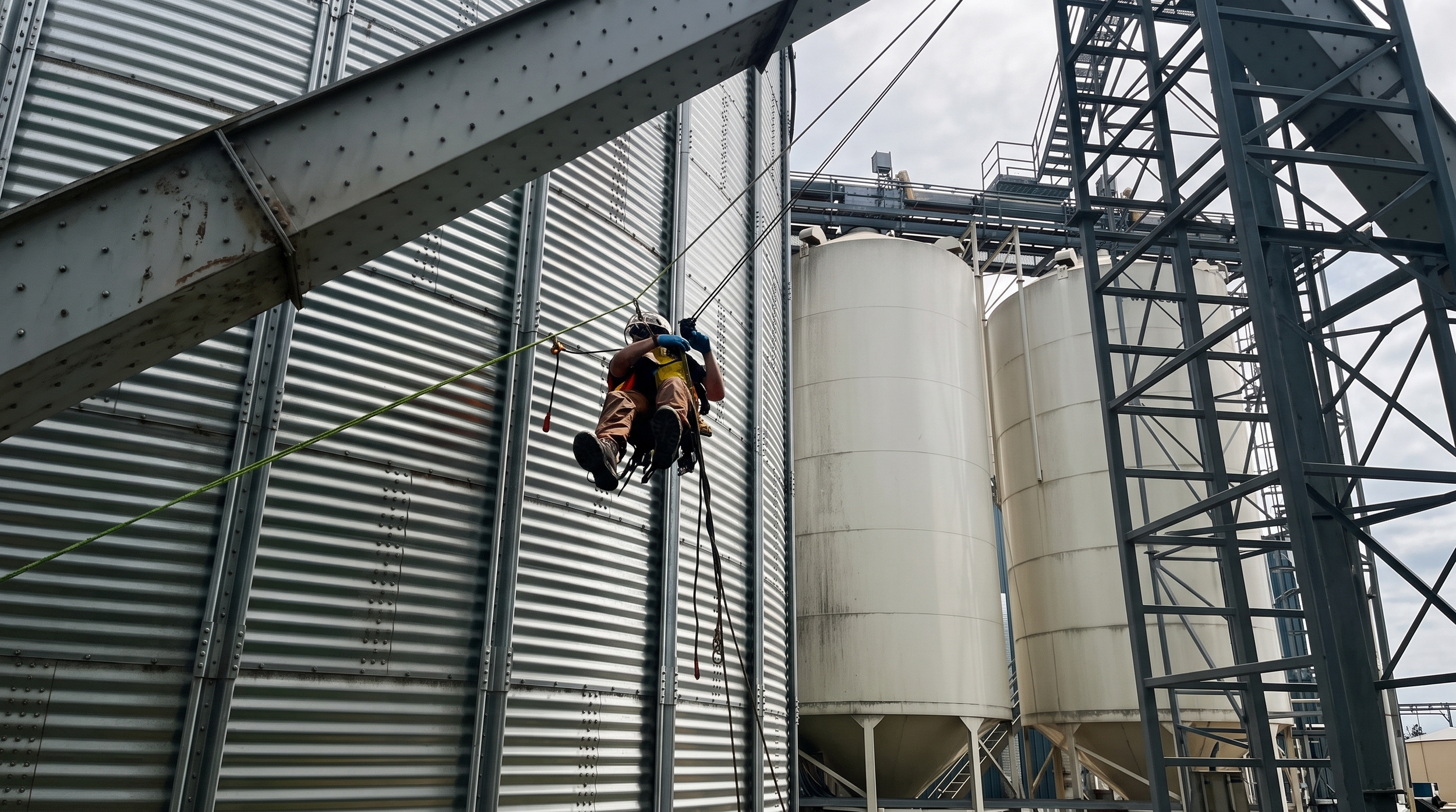
IRATA-certified APEX rope access technician suspended alongside the corrugated grain storage structure during the emergency chute repair.
The Challenge: A Race Against Product Loss
Every emergency has a clock. This one had two.
The first clock was the product itself. A leaking material chute doesn’t pause for a purchase order. The facility was watching material escape at multiple leak points, and the total loss climbed with every hour the structure stayed compromised. The second clock was operational. Agricultural facilities run on tight windows. Shutting down ongoing processes to accommodate a lengthy repair means lost throughput on top of lost product. That’s a second wound layered on the first.
So the facility faced a genuinely hard question. How do you fix something high up, fast, without stopping everything else you’re doing? Traditional access answers that question badly.
Why Traditional Access Fails in an Emergency
There’s a reason scaffolding and aerial lifts dominate so many job sites. For certain long-duration, ground-supported work, they’re the right call. But drop them into a time-sensitive repair on an irregular structure and their weaknesses show up fast.
Scaffolding is slow to build. A scaffold tall enough to reach an elevated chute isn’t a same-day job. It requires engineering, materials, a build crew, and inspection before anyone can safely climb it, and the whole process runs in reverse when the work is done. That’s days of labour bracketing a repair that might take hours.
Aerial lifts need room the site may not have. Boom lifts and scissor lifts require stable ground, clear approach paths, and enough open space to position and maneuver. Agricultural sites are crowded with silos, augers, chutes, catwalks, and support steel. The exact structures that need servicing are often the ones a lift can’t get close to.
Both carry rental and mobilization costs that stack up fast. Equipment rental, delivery, operator time, and standby charges add up whether the machine is working or waiting. For a one-day repair, the access method can cost more than the fix itself.
Both expand the footprint of the job. More equipment on site means more coordination, more disruption to ongoing operations, and more moving parts to manage safely.
In a non-emergency, you can absorb all of that. In an emergency, it’s exactly the friction you can’t afford.
The Rope Access Advantage: Speed, Reach, and a Smaller Footprint
Industrial rope access flips the equation. Instead of building a structure to reach the work, a technician uses the structure that’s already there, rigging directly to suitable anchor points and moving to the exact spots that need attention.
The advantages line up almost perfectly with what an emergency demands:
Fast mobilization. A rope access team arrives with gear that fits in a truck, not a fleet. There’s no scaffold to build and no lift to deliver, so the time from approval to working is measured in hours, not days.
Precise reach. Ropes go where machines can’t. A technician can position at awkward angles, tight gaps, and multiple elevations across the same structure in a single visit.
Minimal footprint. The equipment is compact, and the setup is quiet. Ongoing operations at the facility can usually continue with little or no disruption.
Built-in redundancy. Every technician works on a dual-rope system: two independent ropes, each capable of holding the worker’s full weight on its own. This isn’t optional. It’s the core of the discipline, and it’s why rope access carries such a strong safety record when performed by certified professionals.
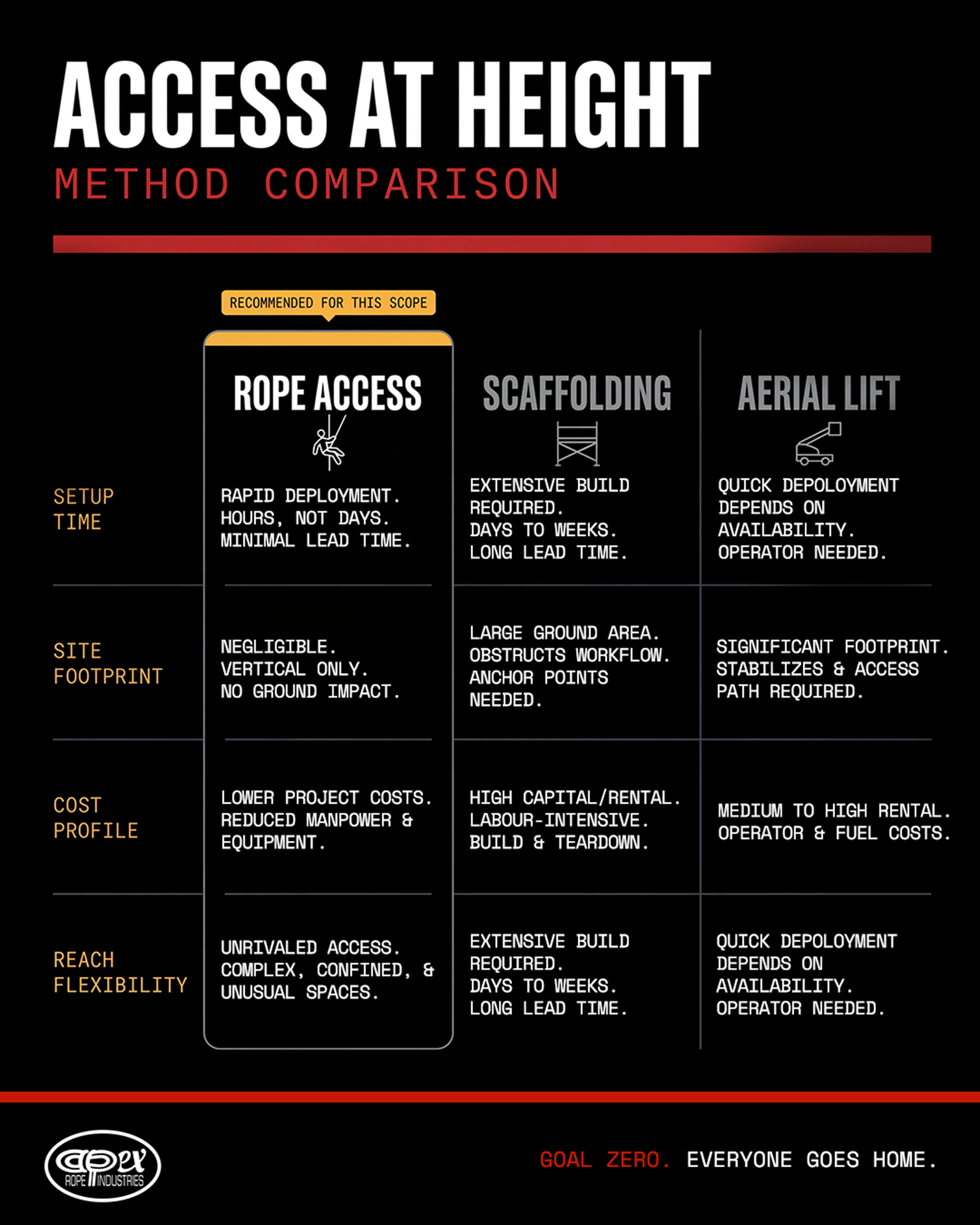
The Solution: How APEX Executed the Repair.
When the emergency call came in, APEX moved.
Mobilized within 48 hours. An IRATA-certified rope access team was assembled and on site within two days of the emergency call. That kind of turnaround only works when a company keeps trained technicians and rescue-ready equipment on standby.
Rigged safe access at multiple elevation points. Rather than a single work position, the team established safe rope access systems at every affected location across the chute structure. Every leak was reachable, with no gaps and nothing left for a second trip.
Inspected and diagnosed in a single visit. While positioned on the structure, technicians inspected all chute connections and identified every leak location at once. There’s real value here that’s easy to miss. Because rope access lets a technician move freely across the whole structure, they don’t just fix the leaks that were reported. They find the ones that weren’t.
Completed all repairs in one working day. With access rigged and every leak mapped, the team repaired all affected areas within a single day on site.
Left the site clean. When the work was done, the team removed all access systems and departed, leaving the facility exactly as they had found it, except for the leaks.
Every step of that sequence was performed under the dual-rope, rescue-planned framework set out in the Alberta OHS Code Part 41 rope access regulations. Speed never came at the expense of the safety margin.
The Results: What One Day of Rope Access Delivered
The numbers tell the story cleanly:
Full scope completed in a single day on site. What traditional access would have stretched across a week of setup, work, and teardown was done in one working day.
Product loss stopped immediately. The moment the leaks were sealed, the spillage ended, and the losses stopped.
Zero dollars spent on scaffolding or lift rental. The facility avoided equipment rental and mobilization costs entirely.
Zero safety incidents. Across all work activities, at every elevation and on every rope, the team maintained a clean record.
No operational disruption. The site stayed fully operational throughout. Ongoing processes never had to stop.
That last point deserves emphasis. In an agricultural operation, uptime is revenue. A repair method that fixes the problem and keeps the facility running isn’t just convenient. It protects the bottom line twice.
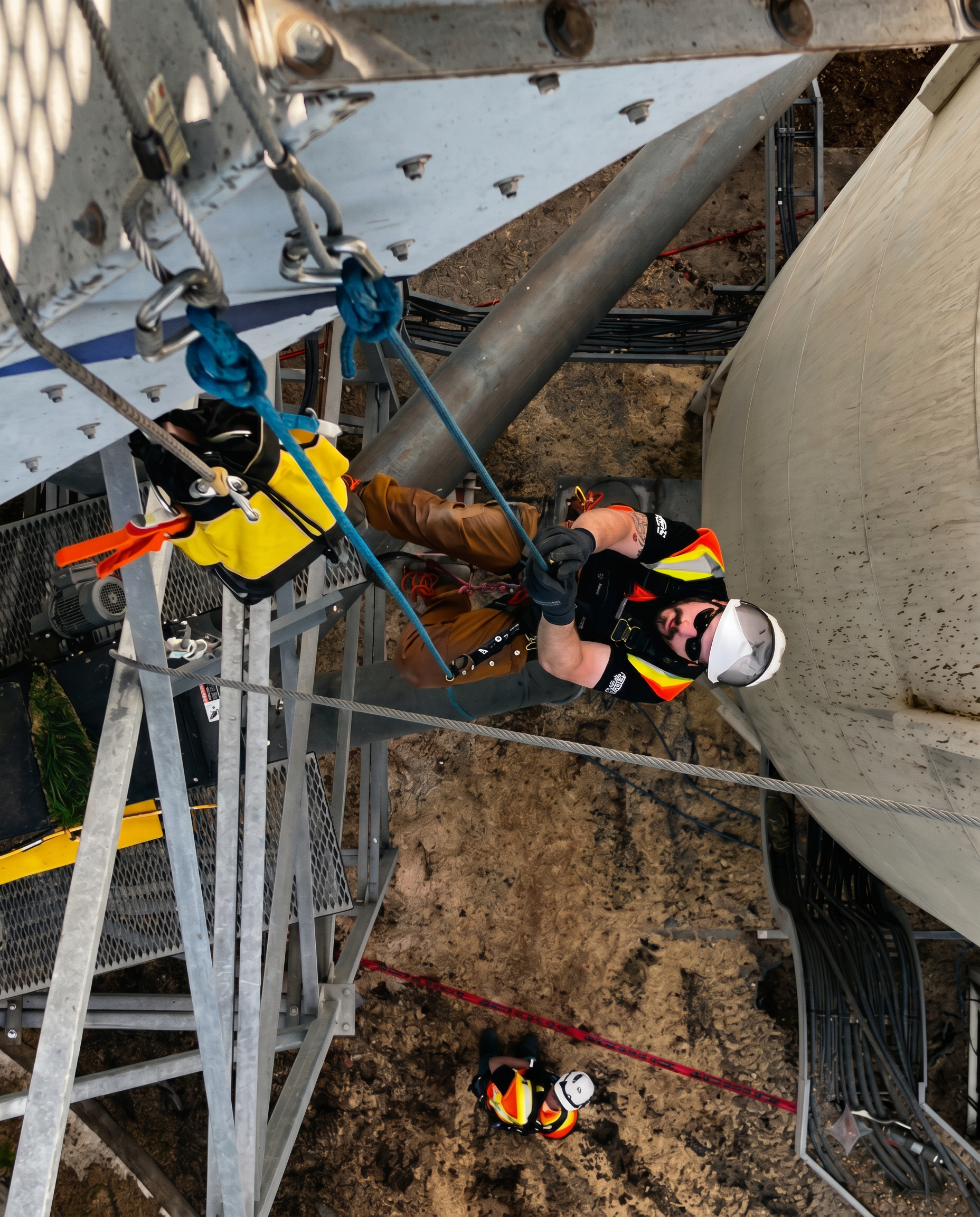
Why Agricultural Facilities Are Turning to Rope Access.
This chute repair isn’t a one-off. It’s a preview of where agricultural maintenance is heading.
Modern grain and material storage facilities are vertical environments. Silos, bins, chutes, augers, catwalks, support towers, and conveyor systems all operate at height and require periodic inspection, cleaning, and repair. Historically, that meant scaffolding budgets and lift schedules, or worse, deferring maintenance until small problems became expensive ones.
Rope access changes the calculus. It makes routine work at height affordable enough to do before it becomes an emergency, and fast enough to handle the emergencies that slip through anyway. A few of the applications where it fits particularly well in the agricultural sector:
Structural inspection of silos, bins, and storage towers
Repair and sealing of chutes, seams, and connection points
Coating, cleaning, and corrosion management on exterior surfaces
Access for confined space entry where certified rope rescue capability is required
That last category matters. Grain storage carries serious, well-documented hazards, with engulfment and confined-space risk chief among them, and those jobs demand specialized entry procedures and rescue readiness. The chute repair in this case study was exterior structural work, not grain entry. But the same rope access discipline that made this repair fast and safe is foundational to the confined-space rescue capability these environments increasingly require.
When Should You Call a Rope Access Team?
Not every job at height needs rope access. But a specific set of conditions makes it the clear right call. Consider reaching out when:
The work is time-sensitive. Emergency repairs, active product loss, or anything where days of setup aren’t an option.
The location is hard to reach. Irregular structures, tight gaps, or multiple elevations that scaffolding and lifts struggle to access.
You need to minimize disruption. Situations where ongoing operations can’t stop for a lengthy access build.
Cost efficiency matters. Shorter-duration work where scaffolding or lift rental would cost more than the repair itself.
The job requires elevated safety margins. Any work at height where dual-rope redundancy and a documented rescue plan are non-negotiable.
If two or more of those describe your situation, rope access is worth a conversation.
Conclusion: The Fastest Way Up Isn’t Always the Biggest Machine
The facility in this case study didn’t need a bigger lift or a taller scaffold. They needed a team that could get up there fast, fix everything in one visit, and leave the site running. Two ropes and a certified technician did what a week of traditional access couldn’t, and did it without a single safety incident or a single dollar spent on rental equipment.
That’s the quiet revolution happening across agricultural maintenance right now. The problems at height haven’t changed. The way the smartest operators solve them has.
When the product is on the ground, and the clock is running, the last thing you want to hear is that setup will take a week. APEX Rope Industries is built for the opposite answer. Based in Calgary and IRATA-certified from the ground up, our teams mobilize fast, work within Alberta’s and Canada’s most rigorous safety standards, and leave your site clean and fully operational.
Facing a maintenance challenge at height, whether planned or urgent? Contact APEX Rope Industries to talk through how rope access can save you time, money, and downtime.